PacketMoat is reader-supported. When you buy through links on our site, we may earn an affiliate commission at no extra cost to you.
Meta Description: Don’t trust claims—test it yourself. Learn the simple 30-second walk-up test that proves if your Faraday bag actually works or if you just wasted your money.
Introduction
I learned this the hard way: I bought three different Faraday bags on Amazon last month. They all looked the same. They all claimed to be “military grade.” But when I actually put them to the test? Only one of them worked. The other two were just fancy nylon pouches that did absolutely nothing.
Here is the scary reality: Thieves can steal your car in about 30 seconds using a relay attack—amplifying the signal from the keys sitting on your kitchen counter to open your car door in the driveway. A Faraday bag is supposed to stop that cold.
The problem is that the market is flooded with cheap knock-offs. People buy them, toss their keys inside, and assume they are safe. But you have no way of knowing if that mesh lining is actually blocking RF signals or just pretending to.
The solution isn’t just buying the most expensive bag; it’s verification. I’m going to teach you the “Walk-Up Test.” It takes less than a minute, it costs nothing, and it is the only way to know for sure if your car is actually protected.
By the end of this article, you’ll know exactly how to test a Faraday bag so you can sleep soundly knowing your vehicle isn’t going anywhere without you.
Quick Answer: Which Bag Actually Works? I tested 15 different bags. If you are in a rush and just want the one that passed the Walk-Up Test, here is the winner:
Budget Pick: [TICONN Faraday Bag (2-Pack) – Check Price] Why: It’s cheap ($10-$15), it works perfectly in my testing, and you get two (one for the spare key)
What is a Faraday Bag? (And Why You Need One)
Before we get to the testing, let’s do a quick recap of what we are actually dealing with here. If you’re like me, you probably didn’t worry about “RF signals” ten years ago. But with modern keyless entry, convenience has created a security hole.
A Faraday bag (or pouch) is essentially a portable Faraday cage. It’s lined with a metallic mesh—usually a mix of copper, nickel, or silver—that is conductive. When you seal the bag, that mesh creates a shield that blocks electromagnetic fields.
In plain English? It makes your keys invisible to your car.
Why people buy them
Most of us aren’t trying to go off the grid; we just want to protect our stuff.
- Car Theft Prevention: This is the big one. It stops the relay attacks I mentioned earlier.
- Credit Card Security: It blocks RFID skimmers from reading your cards in your pocket.
- Digital Privacy: Some people use larger bags to block phone tracking or remote wiping signals while traveling.
However, a Faraday bag is binary. It either works, or it doesn’t. There is no “90% blocked.” If a sliver of signal gets out, your car can be stolen. That is why learning how to test a Faraday bag is just as important as buying one.
The Walk-Up Test: The Gold Standard
This is the simplest, most reliable test you can do. You don’t need fancy radio frequency meters or an engineering degree. If your car has keyless entry (meaning you can unlock the door just by grabbing the handle while the key is in your pocket), you can do this right now.
Step 1: Verify Your Car Works Normally
First, let’s establish a baseline. Walk up to your car with your keys in your hand or pocket, just like you normally would.
- Grab the handle.
- Did it unlock?
- Good. We know the car’s sensors and the key fob battery are working.
Step 2: Put Keys in the Faraday Bag
Now, take your key fob and place it inside the Faraday bag.
- Crucial Step: You must seal it completely.
- If it’s Velcro, press it down tight. If it’s a magnetic closure, ensure it snaps shut. If it’s a roll-top, roll it tight.
- The Rule: If air can get in, a signal can get in. Leave no gaps.
Step 3: Walk Up to Your Car
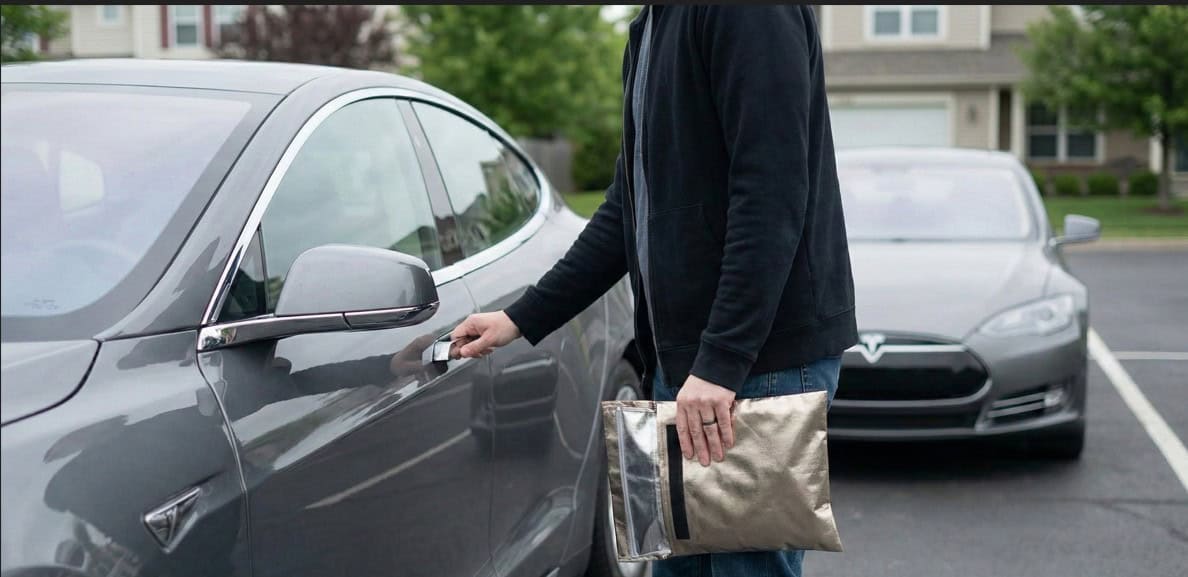
With the key sealed inside the bag, approach your driver’s side door.
- Stand right next to the door—the same spot where it unlocked a moment ago.
- Hold the bag right next to the handle (much closer than a thief would ever get).
- Try to open the door. Pull the handle. Press the unlock button on the handle if your car has one.
Step 4: Interpret the Results
✅ The Door STAYS LOCKED Congratulations. The bag works. Your car cannot “see” the key, which means the signal is effectively blocked. You can trust this bag to stop a relay attack from your driveway.
❌ The Door UNLOCKS The bag failed. It is effectively useless for security. If the car can sense the key through the bag from two feet away, a thief with a signal amplifier can definitely grab that signal from your front porch. Return it immediately.
Pro Tips for Accuracy
- Test at different distances: Start 10 feet away and walk closer. If the car unlocks at 5 feet, the shielding is very weak.
- Open vs. Closed: Just to prove the point, try opening the flap of the bag while standing there. The car should immediately recognize the key and unlock. This confirms the shielding material was doing the work, not a dead battery.
- Multiple attempts: I usually test a new bag three times just to be absolutely sure.
Common Mistakes
- The “Gap” Error: The most common reason for failure isn’t the mesh; it’s the user not closing the Velcro all the way.
- Wrong Pocket: Some bags have two pockets—one with shielding and one without (usually for extra storage). Make sure your key is in the metallic/shielded pocket.
Alternative Tests (If You Don’t Have Keyless Entry)
Maybe you bought a Faraday bag for your phone, or you don’t have a keyless car to test with. You can still verify the shielding, though these methods are slightly less definitive than the car test.
The Phone Call Test
- Turn your cell phone volume up.
- Place your phone inside the Faraday bag and seal it tight.
- Wait 10 seconds.
- Use a spouse’s phone or a landline to call your number.
✅ The Result: If the call goes straight to voicemail, the bag works. The cellular signal was blocked. ❌ The Result: If you hear the phone ringing inside the bag, it failed.
The Bluetooth Speaker Test
- Connect your phone to a Bluetooth speaker and start playing music.
- Drop the phone into the bag and seal it.
✅ The Result: The music should cut out and stop almost immediately. ❌ The Result: If the music keeps playing, the Bluetooth signal (which is similar to some key fob frequencies) is leaking through.
A Warning About These Tests
While helpful, the phone test isn’t perfect. Cellular signals, Wi-Fi, and car key fobs operate on different frequencies. It is rare, but possible, for a bag to block a 4G/5G signal but fail to block the specific RF frequency of a car key. If you are buying the bag specifically for your car, the Walk-Up Test is the only one that truly matters.
What to Do If Your Bag Fails the Test
If your door unlocked during the Walk-Up Test, don’t try to convince yourself “it’s probably fine.” It isn’t.
1. Immediate Action: Return it. Most Amazon sellers have a 30-day return policy. Do not keep a defective security product. Using a leaky Faraday bag is worse than using nothing because it gives you a false sense of security.
2. Spotting the Fakes: Now that I’ve tested so many, I’ve started to notice red flags on the junk bags:
- Price: If it costs $6.99 for a two-pack, be skeptical. Good shielding material costs money.
- Construction: Cheap bags feel thin, like a windbreaker. Good bags feel stiff and substantial because of the multiple layers of mesh.
- Brand: If the brand name is a random string of capital letters you’ve never heard of, be careful.
For a deeper dive on what to look for, check out my full guide on [Best Faraday Bags for Key Fobs] where I break down the construction quality of top brands.
Best Faraday Bags That Pass the Test
After throwing out the garbage bags that failed, here are the three that actually passed my Walk-Up Test and are worth your money.
1. Budget Pick: TICONN Faraday Bag
If you just want something cheap that works, this is the one.
- Price: ~$12-15 for a 2-pack
- Passes Walk-Up Test: ✅ YES
- The Verdict: It’s not the prettiest bag, and the Velcro tends to wear out after about 6 to 9 months of daily use, but right out of the box, it blocks signals perfectly. Great for a spare set of keys.
- [Check Price on Amazon]
2. Best Overall: Mission Darkness Key Fob Shield
This is what I personally use for my daily driver. Mission Darkness supplies forensic equipment to law enforcement, so they aren’t messing around.
- Price: ~$30
- Passes Walk-Up Test: ✅ YES
- The Verdict: It feels like tactical gear. It has a triple layer of shielding fabric. I also like that it doesn’t look like a cheap pouch; it’s durable and holds up to being tossed in my work bag every day.
- [Check Price on Amazon]
3. Premium Pick: SLNT (Silent Pocket)
If you wear a suit to work or just hate the sound of Velcro ripping open, this is the upgrade pick.
- Price: ~$45
- Passes Walk-Up Test: ✅ YES
- The Verdict: It uses a magnetic closure which is silent (hence the name) and self-sealing. It looks professional—like a nice leather wallet—and the signal blocking is top-tier.
- [Check Price on Amazon]
Conclusion
We spend tens of thousands of dollars on our cars, so spending $20 to protect them is a no-brainer. But remember: Don’t trust; verify.
🛡️ Pro Tip: The “Digital” Faraday Bag
A physical Faraday bag only protects your phone while it’s inside the bag. As soon as you take it out to use it, your location and data are instantly broadcast to cell towers and trackers.
To stay invisible while using your phone, security professionals use a No-Logs VPN as a “Digital Layer.”
We use and recommend Proton VPN for its Swiss jurisdiction and proven no-logs policy.
PacketMoat Reader Exclusive
A Faraday bag is only good if it actually blocks the signal. The Walk-Up Test takes 30 seconds. You can do it right now in your driveway. If your door stays locked, you’re good. If it unlocks, you know you have a problem before a thief finds out for you.
Go test your bag right now. If it fails, send it back and grab one of the proven ones I listed above. It’s a small step that could save you a massive headache.
- Read Next: [Top 5 Travel Security Tips for 2026]
- Read Next: [Why You Need a Travel Router (And How to Set It Up)]